
The Reason for the Reason
The Facepalms Begotten of Language Mess

In this special holiday edition of Philosophy Stan, we’ll be returning the White Elephant gift of terminal-yet-normative reasons, which promised to bring us goodness & light… yet left us in the dark!
The Forcible Flow of Framing
Pauline says she’ll kill Michael with her crossbow unless Michael throws a tomato at Prince Erik’s head as the prince passes by.
How might we describe the choices available to Michael?
Michael can either throw the tomato as instructed, or refuse and risk death. Hence he has 2 choices.
Pauline has limited Michael’s choices; Michael has only one choice; Michael has no choice but/except to throw the tomato. Hence he has 1 choice.
Pauline has robbed Michael of all choice. Michael has no choice. He must throw the tomato. Hence he has 0 choices.
So, how many choices does Michael have? You must pick only one of the above 3 options, or I shall kill you with a crossbow.
… Or shall I?
My intimidating expression suddenly relaxes to a knowing grin. I knew you’d refuse to pick any of the above. I’ve taught you too well. Orrrr you learned the right way to philosophize on your own. Either way, props. I’ll now shoot my crossbow harmlessly into the sky.
Yes, smarty, you knew that none of the answers (2, 1, or 0) are strictly right vs. the others; it just depends on the framing being used, e.g., what are the criteria to count as “choice.” We sometimes set the bar for “viable option” as being unlaced with certain death, among whatever other criteria.
Furthermore, the 3rd framing trades on the polysemy of “choice,” where a speaker by “has no choice” may not be referring to the options as choices (the options of which Michael is robbed), but the act of selecting among multiple viable options (the act of which Michael is robbed).
Okay.
But what if we didn’t think of all that?
What if a philosophy text engaged in an exploration of agency, responsibility, decisionmaking, etc., but leaned heavily on only one of the above? What if it peppered you, the reader, with examples from common language habits and with familiar phrases but only those that reflected the one they preferred? What if it contained multiple thought experiments all tailored to sell that perspective only? Would you notice what it was doing, or would you find yourself caught in the net of a particular “philosophical intuition” (i.e., familiar way of thinking & talking) that supported the author’s conceptual orchestration and chosen “choice” tally?
You’d get caught! Because we all get caught by this weird riptide when we’re reading charitably, and the only people who resist it are insufferably pedantic nerds who think about this kind of language minutia all the time, creepily paying attention to how they and others talk.
So, one might say it is the duty of such nerds to write articles about this kind of thing.
Shamrock Insertion
You know stage magic? If you’re charitably watching a magic act, your eyes follow where the magician points. But if you’re Penn & Teller, magic detectives supreme, your eyes look everywhere else, too. It has little innately to do with intellect, but with trust (or lack thereof), interest, and targeted observation.
A problem with philosophy is that the proverbial magician is often tricking himself, too. Imagine a magician with Alien Hand Syndrome (with an especially obsequious alien left hand). With their right hand they wave the wand above the hat, their gaze fixed upon it. But their left hand is sneaking a shamrock🍀 through a small opening in the hat, which the left hand had earlier incised. When this magician shouts “Abracadabra!” and finds a shamrock in his hat, he will probably feel his “Abracadabra” was a legit incantation and that he enjoys legit supernatural powers to manifest shamrocks in hats!
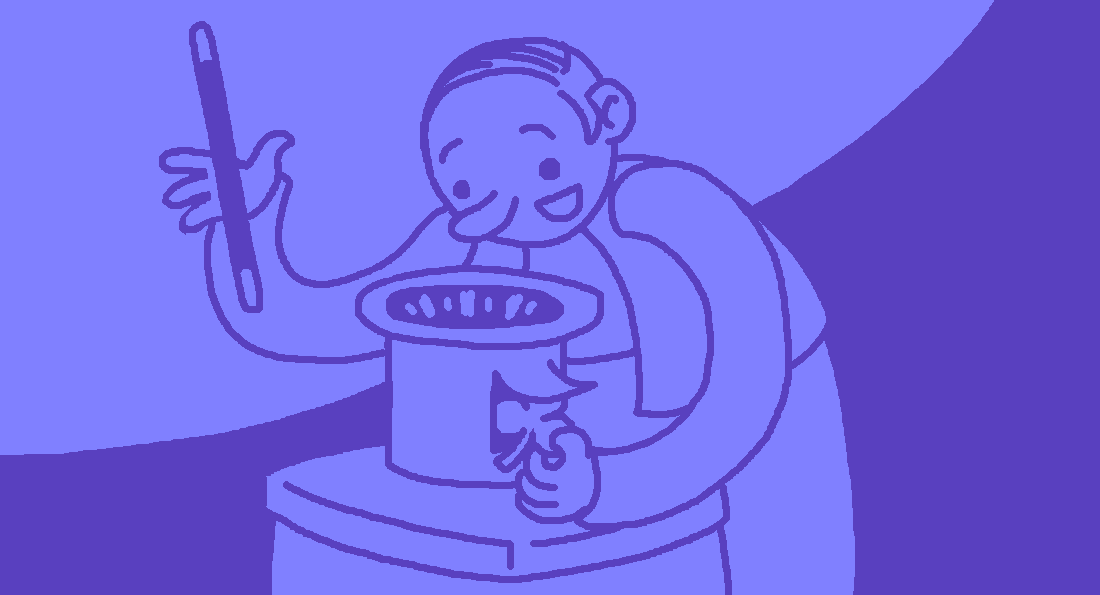
Well guess what? That happens to philosophers, too. If a philosopher is just going off of “philosophical intuition” (i.e., familiar ways of thinking & talking), leaning heavily on principles & phrases in sync with those ways (“ought implies can,” “didn’t really choose,” etc.) and neglecting principles & phrases out of sync, they’re going to find their hat magically brimming with shamrocks, ready to distribute. Neither the well-meaning philosopher nor the charitable audience will quite know what produced them, but many are rather impressed.
And in the end, isn’t that What Matters? (Sarcasm!)
The Problem of the Smuggled Criterion
Last year we talked about how, paradoxically, it’s Stance-Independently Wrong to Murder on Moral Anti-Realism. This is because while “it’s wrong to murder” may not appeal to any cares or concerns (which is usually what those stances are reflecting), the concept “murder” itself harbors its own “this wrong”-ness. Its own anti-shamrock, if you will.
And this is why we are forced away from the elegant,
All true moral propositions have something about them that draws from cares & concerns.
… and toward the clunky,
All true moral propositions have something about them that draws from cares & concerns, or are true by mere conceptual redundancy (e.g., “morally-wrong-dancing is morally wrong”).
That article had an addendum pointing out a common issue we see with terms that have a kind of polysemy across the degree to which they are laden with “shamrock” criteria:
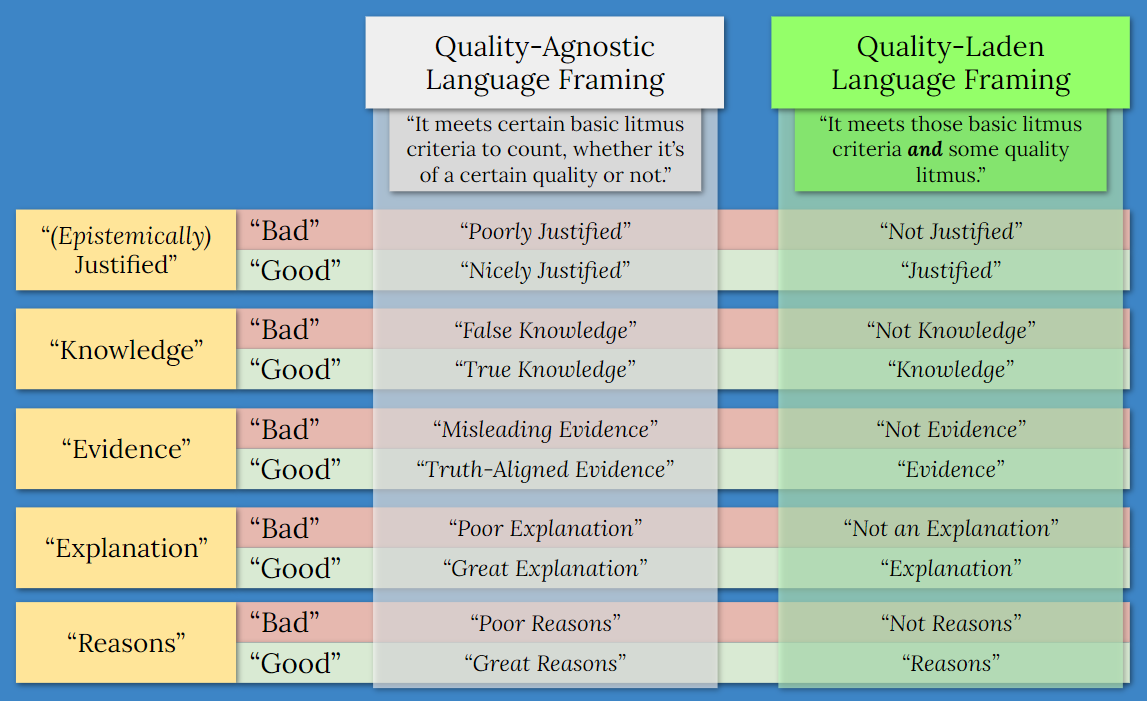
If for example your criteria for an act to count as justification is pretty loose, then you might be willing to say that in both of these cases, the characters justified their belief:
Amy subjected her belief to rigorous scientific testing & outside replication, resulting in approval of her belief.
Bill shouted his belief into Splashy the “Lucky Town Well”; his voice echoed back, which to Bill meant approval of his belief.
If however we have higher standards for what it takes for something to count as “justified” at all, then we might say that Amy’s belief is justified, but Bill’s is not.
(Or we’d say the reverse, if we’re conspiratorial Splashians).
So what would happen if we have Amy’s kind of justification in mind when we ask about whether Bill’s belief is justified, but the person we’re asking has a lower-bar concept of justification in mind? That person might say, “Yes, technically, Bill’s belief is justified.” And yet because of our higher-bar criteria, we interpret that to mean that Bill’s belief has been subject to intense critical scrutiny, something far beyond Splashy.
And if you think philosophers are careful with that term, boy do I have bad news for you. Underspecification, facile bivalence, and “Splashy-sourcing” abound.
Don’t get me wrong. Most every term is polysemous, but you don’t see me going after everything. Where polysemy gets dangerous is when those wrinkles arise and rhetorical opportunities come with them, which both bad actors and “alien hands” are prone to exploit.
Now scroll back up to that chart. See the word on the very bottom?
We’re finally ready to talk about reasons and an alien hand shamrock sham that shows up. (Imagine seeing that line out of context.)
OKAY, SO….
… the very same thing we just did for “justification” we can do for “reasons,” and the fact that we can slice reasons by different “angles” of criteria is enough for us to know that reasons aren’t primitives. They come in all different flavors, like Jolly Ranchers.
Stan Patton: Here we sometimes get tripped up by more-descriptive vs. more-normative polysemy on “reason,” between the more descriptive “[poor reason / good reason]” framing and the more normative “[not a reason / reason]” framing. When we blur these language frameworks it allows a zig-zag maneuver from “poor reason” to “reason” to “good reason.”
Josh Rasmussen: And even “good” reason is ambiguous between a normative interpretation and a neutral description of strength / doxastic force.
And per Josh’s reply, even the chart I provided above is too simple. There are myriad different criteria by which a reason can be judged, and it’s rarely as facile as “poor or great.”
The villain had sinister reasons to destroy the innocent creature.
The oaf had ill-conceived reasons to bed his life savings on the lottery.
The warrior had selfish reasons to keep fighting.
The warrior had selfless reasons to keep fighting.
The warrior had strategic reasons to stop fighting.
Bill had time-honored reasons to consult & heed Splashy.
Oskar Schindler had noble reasons to save lives through deception.
Some of the qualifiers above have venerable overtones, and others are rather pejorative. But some could go either way (a selfless sacrificial act for a comrade can be bad in the eyes of a widowed wife; something might be strategic but for evil ends; the honor that time bestowed Splashy is dubious indeed; etc.).
Reasons clearly aren’t “terminal”; man alive, they’re just a single paddle up the diagnostic stream! They’re the cause⏩, the motivation⏩, the explanation⏩, the thinking-behind-it⏩… but being a reason⏩ doesn’t mean it’s good🍀. They’re just responses to “Why?”!
One safe, preventative tack is to just say there aren’t “Reasons🍀” (and run a lance through such ideas); instead, there are just reasons⏩, and they can suck. And that’s all there is to it.
Q: Why then would one say “He has reasons🍀 to do X”?
A1: Because that’s shorthand for “has good🍀 reasons⏩ to do X.” In linguistics this is called ellipsis.
A2: Or one could see it not as ellipsis, but as a normatively laden, high-bar concept of the term (like how most of us see Amy’s effort of justification). This of course invites the danger discussed before.
So just as we slice apart the normatively-laden terms “has evidence,” “has justification,” “is explained,” etc. to deflate & disarm them, we’ve now done so with “has reasons,” and the only so-called “philosophical intuitions” we’ve offended are those junky language habits we can do with or without.
Practicing Pants-Up Philosophy
I’m going to assume that we’re all on the same team for the rest, because now we’re going to get a little feisty.
As a concluding exercise, we will take our more boring understanding of “reasons” and use it to scrutinize four statements published back in 2011. In light of our prophylaxis, are the statements below “passing muster” / “on par” / “fit”?
Here we go.
Statement #1:
Like some other fundamental concepts, such as those involved in our thoughts about time, consciousness, and possibility, the concept of a reason is indefinable in the sense that it cannot be helpfully explained merely by using words.
We reply:
Whoa there, sure it can! It’s just the cause, motivation, explanation, or thinking-behind-something. “The reason I opened the window was to let in fresh air”; “The reason for the mudslide was the conjunction of excessive forestation & excessive rain”; etc. Bare reasons are descriptive⏩, but we often cast judgments upon them if they involve behavior. Those judgments are per standards beyond the reasons. Typically, when we invoke reasons as supplying rationales, we are implying that they are the good🍀 species of reasons which passed our judgments per such standards. But when we do so we’re on shaky ground because those judgments and their standards are so often left unspecified for brevity.
Easy!
Statement #2:
These claims have been about about normative reasons. [By contrast,] when we have such a reason or apparent reason, and we act for this reason, this becomes our motivating reason. If I avoid walnuts, for example, my motivating reason might be that, as my doctor has told me, eating them would kill me. This distinction is clearest when we have only a motivating reason for acting in some way. If you ran away from the angry snake, your motivating reason would be provided by your false belief that this act would save your life. But, as I have said, you have no normative reason to run away. You merely think you do. In an example of a different kind, we might claim: ‘His reason was to get revenge, but that was no reason to do what he did.’
We reply:
We don’t have to say “motivating reason,” but just “motivation/reason.” Then some of those motivations/reasons pass certain norming judgments, and others fail such judgments. Easy!
The on-its-face contradiction in the revenge case is trivially resolved by specification: “His reason[failing our behavioral standards] was to get revenge, but that was no reason[passing our behavioral standards] to do what he did.” Easy!
We can see that this comes down to judgments, and not some profound categorical chasm, by repairing the “angry snake” thought experiment so that it does not grant us, the readers, a foregone conclusion. This is a major flaw in many thought experiments, and here the writer leveraged the common wisdom that a slow retreat is the right move against an angry snake to cast judgment on the motivation to flee.
Instead of saying “your false belief,” we can just say “belief,” and use some reptile against which the most probable survival strategy is unknown.
What suddenly happens to those motivating vs. normative tags?
Well, look at that: They react to our alteration, mutating in direct response to our inability to conclusively judge. And if we proceed to grant you with knowledge that fleeing is the safest bet vs. this particular reptile, then suddenly fleeing enjoys the normative tagging!
Normativity was a function of strategic norms all along, in turn normed by (i.e., owing to) upstream cares & concerns about self-preservation and whatever else.
… Easy!
Statement #3:
When we call something good, in what we can call the reason-implying sense, we mean that there are certain kinds of fact about this thing’s nature, or properties, that would in some situations give us or others strong reasons to respond to this thing in some positive way, such as wanting, choosing, using, producing, or preserving this thing.
We say:
Now hold the phone! What’s that alien-handed “strong” doing there!?
We know by now what that “strong” is up to. It’s just “good”🍀 in disguise! This isn’t adding information, it’s just a conceptual loop! What in tarnation!
Statement #4:
Consider first an imagined man who has an attitude that we can call Future Tuesday Indifference. This man cares about his own future pleasures or pains, except when they will come on any future Tuesday. This strange attitude does not depend on ignorance or false beliefs. Pain on Tuesdays, this man knows, would be just as painful, and just as much his pain, and Tuesdays are just like other days of the week. Even so, given the choice, this man would now prefer agony on any future Tuesday to slight pain on any other future day. That some ordeal would be much more painful is a strong reason not to prefer it. That this ordeal would be on a future Tuesday is no reason to prefer it. So this man’s preferences are strongly contrary to reason, and irrational.
We say:
“No” reason? Maybe no good reason per your attitudes, but certainly not his attitude, which you called “strange.” This is just a strange reason.
Easy.
END EXERCISE
Now, had we been charitably pliant, we’d have been caught in the riptide of these familiar, friendly phrases (“strong reasons,” “no reason,” etc.) and those stacked experimental situations. We would have been swept out to sea in thinking that “reasons” were some sort of strange primitive upstream of our judgments and standards thereof.
But because we did our own exercises ahead of time to calibrate our so-called “philosophical intuition” (by reminding ourselves of the diverse ways we think & talk), and because we didn’t take the thought experiments for granted, and because we didn’t uncritically accept the suggestion that tighter specification was unavailable, we weren’t caught with our pants down.
Hence, when it comes to facing philosophical texts like these, we have reasons to be suspicious, reasons to calibrate, and reasons to practice targeted observation.
Ahem… good reasons, I should say.

Post-Credits Teaser
You may have noticed that each of the articles on this blog have employed a certain way of dissolving things and getting boringly forthright. The odd patterns, sneaky bugs, and worrying incentives all point to a single thesis: “People, their weird proposals, and their mindfreak puzzles get showered with attention through nothing more than underspecification + overconfidence. Those two things alone are enough to explain the most viral, quicksandy discourses in philosophy.”
As boring as we’ve been, the undercurrent has (of course) been a little radical. We’ve interrogated metaphysics, ontology, identity, equivalence, modality, epistemology, meta-ethics, and language, particularly the myriad terms that cause polysemous havoc when left off-leash, and the deluded conceptual absolutism that screeches, “It’s okay! I promise he’s a good boy!”
But you might be wondering, “Where’s all this going? You’ve been slicing terms in half for over a year, but it seems like you’re waging an infinity war. Is there an endgame?”
The answer is yes.
This is all leading to something very special indeed.
Thanks for recommending the article Stan. I especially like the observation about how ordinary it is to qualify the word "reasons" with all kinds of other normatively loaded adjectives likes "selfish", "noble" and so on. It's strange how often defenses of realism will appeal to the ordinary uses of such language as if it unproblematically supports the theory.
👏🏻👏🏻👏🏻